Blog
How to Identify Refrigeration Copper Pipe Sizes: A Practical Guide for HVAC-R Technicians | LRS-PRO
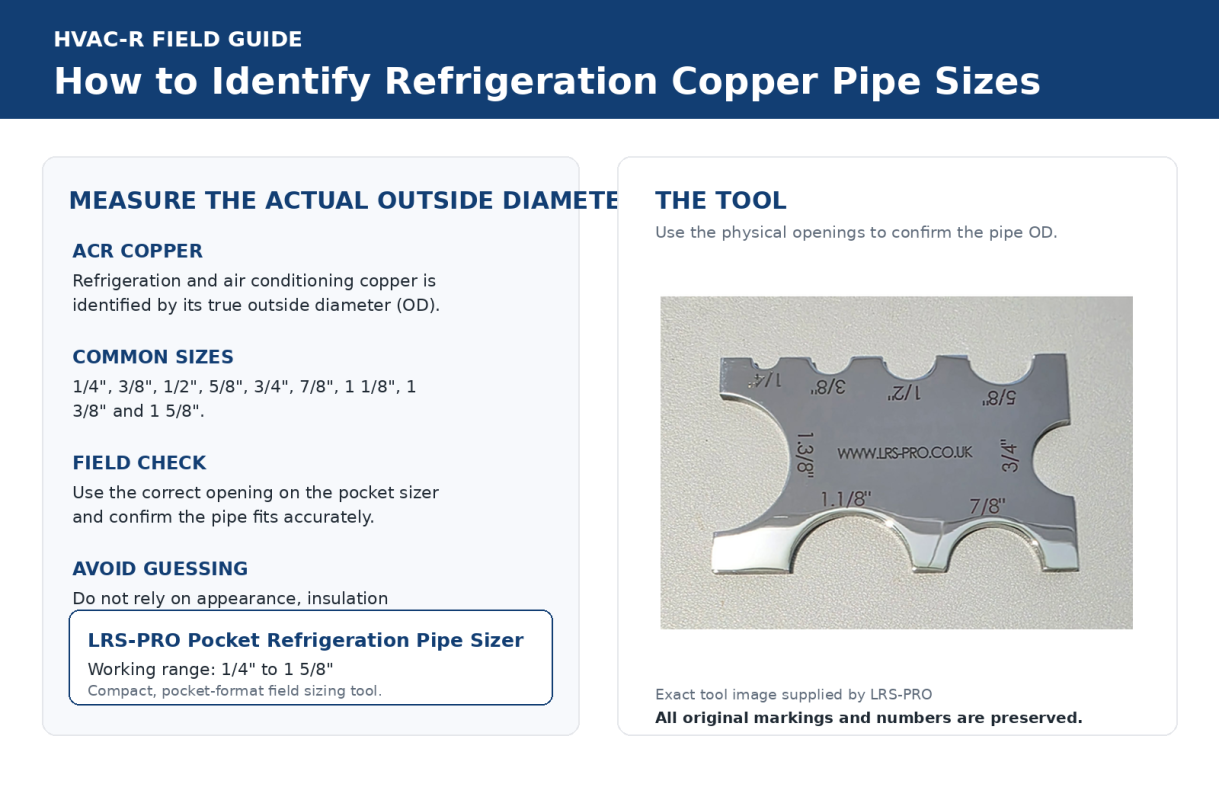
How to Identify Refrigeration Copper Pipe Sizes: A Practical Guide for HVAC-R Technicians
Learn how to identify refrigeration copper pipe sizes by true outside diameter, compare ACR and plumbing copper, measure pipe accurately and avoid common HVAC-R sizing mistakes.

Why Correct Refrigeration Pipe Sizing Matters
Correct pipe identification is important before ordering fittings, cutting replacement tube, brazing a joint or diagnosing an existing refrigeration system. The first step is understanding exactly how refrigeration copper is sized.
This guide explains the difference between ACR copper and plumbing copper, the common refrigeration pipe sizes technicians encounter, practical ways to measure pipe on site, and why a dedicated pocket pipe sizer can make the process faster and more repeatable.
1. Understand That Refrigeration Copper Is Sized Differently From Plumbing Copper
This is one of the biggest sources of confusion on site, so it is worth getting straight first.
ACR Copper – Actual Outside Diameter
ACR copper means Air Conditioning and Refrigeration copper – the tube commonly used for refrigerant lines. It is sized by its actual outside diameter (OD).
If a length of ACR tube is labelled 3/8″, it genuinely measures 3/8″ across the outside.
Plumbing Copper – Nominal Diameter
Plumbing copper uses a different sizing convention. Nominal diameter is not the same as the true outside diameter of the tube.
This is why refrigeration and plumbing copper should not be treated as interchangeable when identifying a pipe size.
2. Know the Common Refrigeration Copper Pipe Sizes
Refrigeration and air conditioning systems use a fairly standard range of ACR copper sizes. The following are common sizes encountered across residential, light commercial and larger commercial work.
| Pipe size – OD | Typical use |
|---|---|
| 1/4″ | Small liquid lines, capillary connections and mini-split liquid lines |
| 3/8″ | Liquid lines on larger splits and small suction lines |
| 1/2″ | Liquid lines on bigger systems and suction lines on small-to-mid splits |
| 5/8″ | Suction lines on residential and light commercial splits |
| 3/4″ | Suction lines on larger residential and commercial systems |
| 7/8″ | Suction lines on commercial and larger split systems |
| 1 1/8″ | Larger commercial suction lines |
| 1 3/8″ – 1 5/8″ | Heavy commercial and industrial suction lines |
Liquid lines are almost always a smaller diameter than the suction line on the same system. If you are identifying an unlabelled pipe, first establish whether you are looking at the liquid or suction line, then use the likely size range as a cross-check.
3. Learn to Read or Reconstruct the Fractional Markings
Refrigeration pipe is commonly specified in fractions of an inch. You will see sizes written as 1/4″, 3/8″, 1/2″, 5/8″, 3/4″, 7/8″, 1 1/8″, 1 3/8″ and 1 5/8″.
New tube usually has the size printed or stamped along its length. On existing installations, however, the marking may be difficult to use because it has been:
- Worn off or affected by oxidation
- Hidden under insulation or lagging
- Positioned behind a wall or equipment
- Never checked before the tube was cut and installed
When the marking is missing or unreadable, a physical pipe sizing tool gives you a direct way to identify the outside diameter instead of relying on a visual estimate.
4. Measuring Methods Technicians Actually Use On Site
A. Pipe sizing gauge or pipe sizer card
A pipe sizing gauge is one of the fastest ways to identify refrigeration copper on an active job. Position the pipe against the sizing openings or scale and find the size that matches the outside diameter. There are no batteries, calculations or mental conversions required.
A pocket-format sizer is particularly useful when you need a quick confirmation while working around condensers, pipework, service areas or other restricted spaces.
B. Vernier calipers
Vernier calipers can provide an accurate measurement when you have a clean cut end or an accessible straight section of copper. The key is to measure directly across the true diameter. Measuring diagonally can produce a larger reading than the actual outside diameter.
Calipers are useful for verification, but they can be less convenient than a dedicated pipe sizer when you need a quick identification during a service call.
C. Wraparound or circumference method
If a tape measure is all you have, you can measure the circumference of the copper and divide that figure by pi, approximately 3.1416, to estimate the diameter.
The method works, but it is more fiddly in the field and easier to misread when working in awkward positions or with cold or gloved hands.
D. Fitting or flare nut comparison
Experienced technicians sometimes compare a pipe with a known fitting or flare nut. This can provide a rough indication, but it should not be treated as the final measurement when ordering replacement tube or specifying fittings.
5. Why a Dedicated Pocket Sizer Beats Eyeballing It
Guessing pipe size by eye is difficult even for experienced technicians. The visual difference between common sizes can be surprisingly small, while insulation, oxidation, paint, lighting and access can make the pipe appear larger or smaller than it really is.
Ordering the wrong compression, flare or connection size.
Cutting tube that does not match the existing pipework.
A joint that appears acceptable but fails under pressure.
Extra time and cost caused by a preventable sizing error.
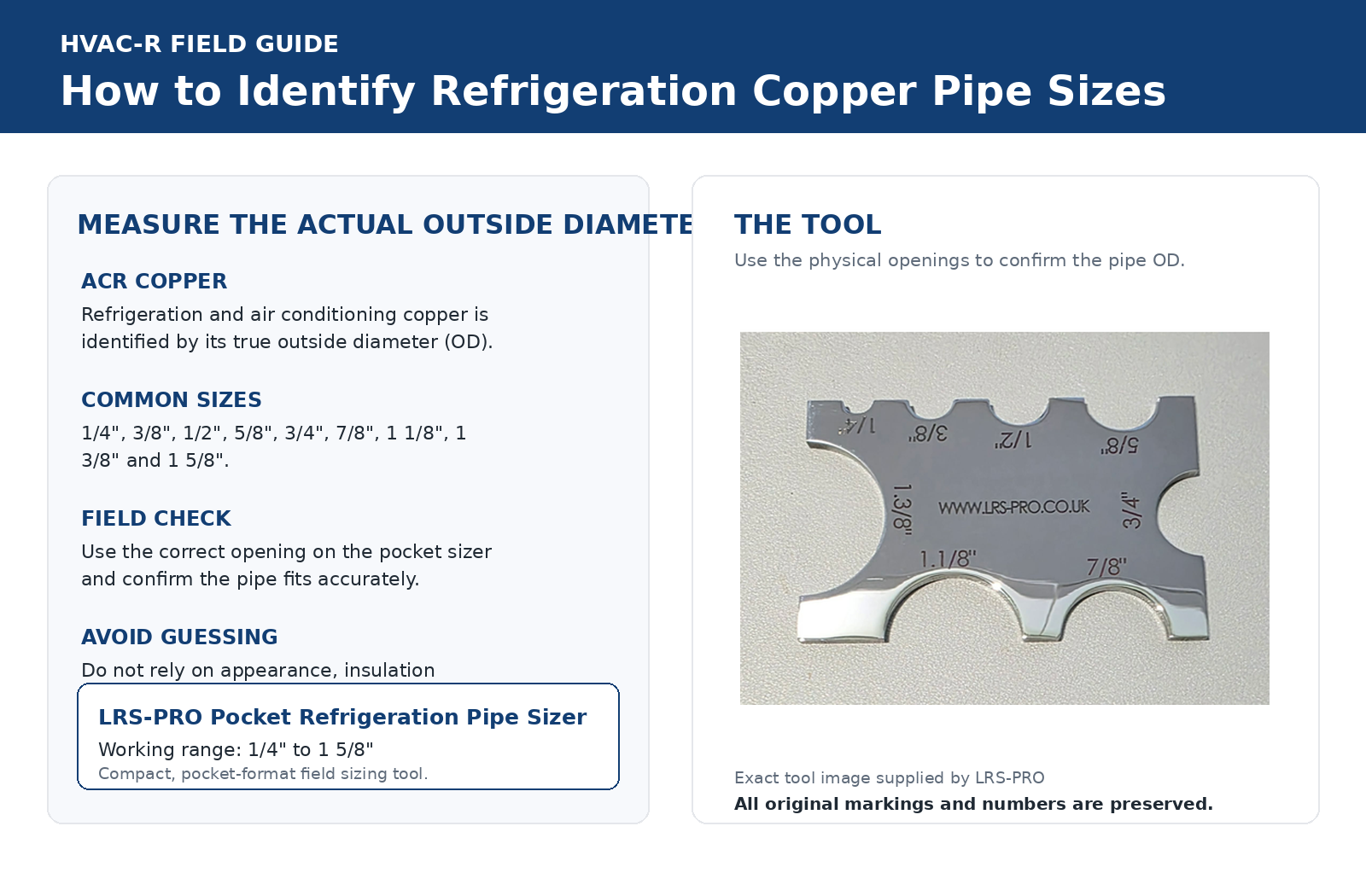
This is the gap the LRS-PRO Pocket Refrigeration Pipe Sizer is designed to address. It is a compact, credit-card-sized tool intended to stay in a wallet or toolkit so it is available when a sizing question comes up.
The LRS-PRO Pocket Refrigeration Pipe Sizer covers the working range from 1/4″ to 1 5/8″. That makes it suitable for checking many of the common refrigeration and air conditioning pipe sizes encountered by HVAC-R technicians.
6. A Simple On-Site Refrigeration Pipe Sizing Workflow
- Identify the line. Establish whether you are measuring the liquid line or suction line.
- Find a clean section. A cut end is ideal, but accessible bare copper can also be checked.
- Check the markings. Look for printed or stamped size information before measuring.
- Measure the actual outside diameter. Use a dedicated pipe sizer for a fast field check or calipers for verification.
- Cross-check the result. Confirm that the reading corresponds with a standard ACR size and the expected system application.
- Record the size. Confirm the dimension before ordering fittings, cutting replacement tube or starting repair work.
7. Common Refrigeration Pipe Sizing Mistakes to Avoid
- Confusing nominal and actual diameter. Always establish which sizing convention applies before identifying the pipe.
- Measuring diagonally. Measure straight across the true outside diameter.
- Trusting faded markings. Old, painted-over or relabelled pipe should be physically checked.
- Measuring the insulation. Measure the copper tube itself, not the lagging around it.
- Skipping verification on repair jobs. Do not assume an existing line matches the size normally used for that system.
- Guessing from a fitting. Use fitting comparison as a rough guide only and confirm with a proper measurement.
Refrigeration Copper Pipe Size Quick Reference
For a fast field reference, remember the common fractional ACR sizes: 1/4″, 3/8″, 1/2″, 5/8″, 3/4″, 7/8″, 1 1/8″, 1 3/8″ and 1 5/8″.
The important point is not simply memorising the list. The important habit is confirming the actual outside diameter before you order parts or alter an existing system.
Confirm refrigeration copper size in seconds
Keep a compact sizing tool close at hand when pipe markings are missing, unclear or inaccessible.
View ProductIn Short
Refrigeration copper is identified by its true outside diameter, and common HVAC-R tube sizes are expressed as fractional inches. When markings are missing or unclear, the most practical approach is to measure the pipe rather than rely on appearance or memory.
A compact sizing tool such as the LRS-PRO Pocket Refrigeration Pipe Sizer gives technicians a quick way to confirm pipe size on site, helping them order the right fittings, prepare replacement tube correctly and reduce avoidable callbacks.
Related LRS-PRO HVAC-R Products
If you are building a practical HVAC-R service kit, you may also want to explore the LRS-PRO range of specialist tools and accessories:
- LRS-PRO Air Conditioning Cleaning Cover – designed to support cleaner and more controlled air conditioning maintenance.
- LRS-PRO Adjustable Magnetic Umbrella Kit for HVAC – hands-free weather protection for exposed outdoor HVAC work.
Frequently Asked Questions
How are refrigeration copper pipes sized?
Refrigeration and air conditioning copper is commonly identified by its actual outside diameter, expressed in fractional inches.
What is the difference between ACR copper and plumbing copper?
ACR copper uses actual outside diameter for sizing. Plumbing copper can use a nominal sizing convention, so a plumbing size should not automatically be treated as the true outside diameter of the tube.
What are the most common refrigeration copper pipe sizes?
Common sizes include 1/4″, 3/8″, 1/2″, 5/8″, 3/4″, 7/8″, 1 1/8″, 1 3/8″ and 1 5/8″. The actual size required depends on the equipment and system design.
Can I measure refrigeration copper with a tape measure?
Yes. You can measure the circumference and divide by approximately 3.1416 to estimate the diameter, but a dedicated pipe sizer or suitable calipers can make field identification faster and easier.
Why should I use a refrigeration pipe sizing tool?
A dedicated sizer provides a quick physical check of the pipe’s outside diameter and reduces the risk of choosing a fitting or replacement tube based on visual estimation.
Need a quick way to confirm pipe size on site?
The LRS-PRO Pocket Refrigeration Pipe Sizer is designed as a compact field tool for checking common refrigeration copper pipe sizes.
View the Pipe Sizer